Showing posts with label expat life. Show all posts

Friday, September 30, 2011

Losing Abu Dhabi


I’ve never been much good at goodbyes. I feel like I should have something profound or at least funny to say, but in the moment I end up being shy and awkward, sputtering out something trite like “it was nice knowing you – take care.” So when I realized I needed to write my final post, I put it off. Admittedly, I’ve also been busier than I anticipated, since I found myself fully employed only days after we arrived, but mostly I’ve been ignoring you all, avoiding the inevitable.

Honestly, I could keep this blog going for some time, as I have a laundry list of impressions and experiences about the transition back to the U.S. – our brief trip to Boston, seeing our families again, the culture shock of living in the South (or strange lack thereof) – that have been accumulating since we left Abu Dhabi. Sometimes I find myself blogging in my head, trying to find the best way to describe my current cultural predicament and wishing I had my camera in hand.

But with Sam fully engaged in school and I immersed in my new work life, it just doesn’t feel right to keep this blog going. Maybe it’s a coping mechanism for dealing with so much change in my relatively short life, but at least for now I need to leave behind all things Abu Dhabi, not to keep comparing then and now, or there with here, but to face forward and embrace what lies ahead. And it would seem that my new schedule and work responsibilities are forcing me to take a good long break from blogging any topic.

So, I guess this is goodbye. It was nice knowing you. Take care.

Coming full circle...Sam and I take our last photo in Abu Dhabi just before our plane leaves the ground.

Monday, September 12, 2011

Hazardous humanitarianism

Those of you who follow our blog on any sort of regular basis know that it has been several weeks since our last post, and most likely you also know this is because we have been in the process of moving back to the States and settling in our new home/jobs in Tallahassee, Florida. Well, so far so good! Hopefully, Shannon will be able to get back to writing soon and can fill you in on the details. But for now I want to talk about something else.

Not long before we left Abu Dhabi I tagged along on a charitable excursion that turned out to be a profound learning experience about volunteerism. I intentionally delayed writing about it because of a minor (and perhaps paranoid) fear that it might incriminate me or others, but also because I wanted some time to reflect on what happened. The purpose of this post is not to lay blame at the feet of anyone in particular, but is more of a cautionary tale, if you like, so that others might avoid what I experienced.

At the church we attended in Abu Dhabi, an announcement was made that a small group of people external to the church had collected a large number of toiletries and clothing donations for a labor camp in Ajman, the smallest and probably poorest of the seven emirates, and were now recruiting volunteers to help distribute the items to the laborers. Even before moving to the UAE I had heard of the deplorable conditions plaguing many of the labor camps, and had hoped that while living there I'd find a way to help those who often end up living lives of de facto indentured servitude. It had turned out to be more difficult than you might think to volunteer for such activities - you can't just show up at the local soup kitchen - so I jumped at this opportunity.

A few days later I rode with a convoy of cars, followed by a truck loaded with the donations, out to the labor camp in Ajman. With our conspicuous arrival to the camp, it didn’t take long for the workers, most of whom were Bangladeshi, Indian, or Pakistani men, to congregate around our vehicles. We were warmly greeted by smiling faces caked in ubiquitous grey dust - evidence of that day's work mixing concrete on the industrial site adjacent to the camp.

As instructed by our group's organizer, our first task was to hand out one empty bag to each worker, which he would then use to collect one of each item we had brought. The “plan” was to have each volunteer take charge of 2-3 piles of items (e.g. bars of soap, pairs of socks) and have the workers walk by each station in a single file line, holding out their empty bags as volunteers added one of each item. Sounds doable, right? 

The first complication arose when we attempted to queue up the men to receive their empty bags. It was during this exercise that I witnessed the degree to which “the line” is a cultural concept, and one that doesn’t hold much cache in south Asia. Even with a translator helping us explain the process, it proved a futile task. In the end, we just waded in among the men and handed out the bags as best as possible. But we discovered that some men were collecting a bag, going off and hiding it, and then coming back and asking for another bag. We had no system in place to prevent them doing this other than the possibility that we would recognize someone who had already been given a bag (and with just about every man wearing the traditional shalwar kameez, this proved difficult, to say the least).


Once the bags were finally distributed, the volunteers manned our respective piles of items while simultaneously trying to direct the men to proceed through each station in an orderly fashion. This went more smoothly than the empty-bag distribution had, although we continuously had to urge the men to move back a few steps because they were increasingly crowding the piles of goods. And after a while, it became evident that some men were going through the line multiple times, while the men who only went through once became visibly frustrated.

I'm not sure how the trend got started, but suddenly the men began bypassing the volunteers' handouts, reaching directly into the piles of donations next to us, and taking more than just one. In the process of doing so, they knocked over a young female volunteer next to me, and I actually had to use physical force to clear them away. Shortly after this development, a few workers got the idea to climb up into the truck and take entire bags of donations from their source, and this quickly spiraled out of control. Wanting to protect the remaining store of items, the truck driver started the engine and began pulling away, while our volunteers in the back literally fought off those trying to climb on board.

After driving around for a while the truck returned, and attempts to climb on board continued. At this point, the lead organizer who was in the back of the truck became so desperate, she began throwing the donations onto the ground, where they were immediately swarmed, of course only stoking the mob mentality that had descended upon the workers. It is important that I say here that this frenzy did not take hold of everyone; some of the workers were trying to keep their colleagues from taking the donations.

I’m sure you’re asking yourself, “why haven’t you left yet?!” Well, we were asking ourselves that same question. The problem was that a number of us were spread out across the grounds with no way of contacting each other (we had not thought to give each other our cell phone numbers beforehand), and no one wanted to leave until we had a full head count. Finally, with our stocks depleted and nothing left for the workers to take, they began to disperse. At last we were able to organize ourselves and collectively leave, each of us with a bitter taste in our mouth.

Humanitarianism sounds noble and praiseworthy, but without thoughtful planning has the potential of doing more harm than good. My purpose in saying this is not to discourage others from volunteering on behalf of the laborers; far from it! The labor camps house people who have unwittingly been stripped of many of their freedoms and are given barely enough to survive in return for long hours of back-breaking hours in extreme weather. While this particular attempt to bring aid to the camps was a bit of a disaster, I know there are extremely successful aid efforts led by competent individuals. My biggest mistake was that I assumed the organizer knew what she was doing and so asked no questions. And while our organizer had good intentions, her biggest mistake was simple lack of planning.

So my advice to those bleeding hearts out there is to keep looking for ways to help, but to ask lots of questions before you join any effort. Ask how you’re getting to and from the site, how the aid will be distributed, and what the plan is for the safety of the volunteers as well as the recipients. After our debacle, I later learned that those particular workers hadn’t been paid in six months! It's no wonder they acted with such desperation. I wish I had known that beforehand. 

Thursday, July 21, 2011

Quitting the UAE: a 12-step program, part 2


Step 5: Close locally-held financial accounts. For us, this was an HSBC credit card, checking and savings accounts. We didn't have any loans, so I can't comment on how to clear these, but the process is probably similar. To be safe, start two weeks prior to your drop-dead date. Before you begin you may want to transfer most of your checking/savings balance to your home bank so that you don't have to walk around carrying all your cash. And once again, it's best to go to the main branch and skip any middle men.


On your first visit you will pay off and cancel your credit cards. Once you've submitted the paperwork, they call you to confirm the cancellation, and if you don't answer they won't follow through. My phone call came 2 days later. Make sure any transfers are confirmed in your home bank and your credit card account is closed before going back to the branch for the second visit, to close your checking and savings accounts. At this time, apply for a letter of no liability, which says you don't owe the bank any money. They will charge a small fee (ours was 50 dirhams). Your final visit, 2-3 business days later, will be to pick up the "no liability" letter.

Step 6: Apply for cancellation of residence visa. This can be done up to 30 days prior to your flight out of the country. My company's visa officer handled the paperwork for me, but I was required to present my passport as well as the passports of anyone I sponsor (i.e. Sam). A day later, the visa officer returned them to me, residence visas inside now stamped with an expiration date 30 days out, at which point Sam and I will officially no longer be welcome here.

Step 7: Cancel your utilities. My employer handled the water and electric clearance, but I had to call the gas company myself. A man came a few days later, wrote down the meter reading, took the gas knob so that I couldn't turn the gas back on, and gave me the address of the distributor office in order to go in person to pay my final bill and obtain the clearance certificate. Oh, and he said I could go only Sunday through Wednesday, between 3:30-5:30 pm to do this. What can I do to get working hours like that?

The next day we showed up in the appropriate window of time at a dilapidated high-rise building, and entered a disheveled office suite filled with stacks of heat-warped papers, one ancient copy machine, and filthy patchworks of threadbare carpet covering the floor. We heard children playing in the next room. We gave our final meter reading to the man behind the desk and asked him how much we owed, skeptical that he could find the answer in such a mess. He told us to have a seat, and immediately began crunching numbers on his calculator. Ten minutes later, he arrived at a figure of 59 dirhams, which sounded good to us. We paid it in cash, and he handed us a clearance letter. Just like that - no return visits required? So simple! I left gratefully, the old adage never to judge a book by its cover ringing in my ears. 

Step 8: Get a housing clearance letter from your landlord, stating you don't owe for rent or damages. This will require some sort of walk-through of the apartment. In our case, a couple of men showed up unannounced and without any explanation, walked around our living room, checked the A/C vents and behind our curtains, asked our move-out date, and left. I was worried this couldn't possibly be enough information to go on; they didn't even look at the other rooms, but a couple of days later a letter was faxed to my employer. 

Step 9: Get rid of the evidence. For me, this meant deleting all my files and turning over my work-issued laptop, cell phone, employee ID, health insurance cards, and a library book. I never invested in my own laptop or phone while here, so this step was the equivalent of hitting rock bottom. I now had nothing left to tie me to my life here in Abu Dhabi, and was totally cut off from the outside world (well, until I borrowed my neighbor's computer to check email the next morning and again now to type this post). But still.

Step 10: Get paid. After steps 1-9 are complete, you should have all the signatures and letters you need to get your final paycheck and gratuity. I went yesterday afternoon to see my HR rep, who handed me a big fat check, shook my hand, and sent me on my way. What a feeling!

Of course, it was in dirhams, and I now had no UAE bank account, so I had to go this morning to my employer's bank to cash the check, then walk across the street to the Exchange with more money in my purse than I had ever carried at one time (it seemed a very long walk), in order to wire it to our bank in the U.S. All I can do is pray it makes it there (I won't find out for 3-4 days), as it is our livelihood for the next several months, or until I find a job, whichever comes first.

Step 11: Say your last goodbyes and finish your bucket list. We've had remarkable experiences the past two years and have no regrets, so for us, this only included finally going to the top of the Burj Khalifa.


Step 12: Pack your bags and board your flight. We'll let you know how this goes. For now, we're signing off for a while. Goodbye Abu Dhabi, and good luck!

Wednesday, July 20, 2011

Quitting the UAE: a 12-step program, part 1

Moving out of the UAE is akin to kicking a bad habit. It requires determination, support, and above all, time. There are those who skip the program and try to go cold turkey (you might call them "absconders," a term I had rarely heard used pre-UAE but is part of daily lingo here). This strategy is risky and rarely works in the long run, so we decided to go the route of legitimacy. After all, we want to be able to pass through the UAE in the future without being nabbed by the airport facial recognition software.

This goal required jumping through many hoops and waiting in many lines, each with their own peculiar pacing and pitfalls. There really should be some kind of support group for this endeavor, but alas, all those who succeed have, by definition, left the country. The only people around to advise you are those who have either never tried to quit or have fallen off the wagon. So I've decided to document our journey. It won't be exactly the same as yours, but perhaps will provide some guidance and encouragement when you find yourself in need.

Step 1: The first step to recovery is always to admit you have a problem. In our little analogy, this means quitting your job. Your employer is typically your sponsor, and without the permission of your sponsor you are legally not free to go. In the States we have a custom of giving "two-weeks notice" of resignation (if you're feeling generous you can give one month). But my UAE employer requires SIX MONTHS notice in order to leave without financial penalty. If your goal is to change employers, the 6-month rule is nearly impossible to keep without a) making a giant leap of faith that you will find a new job after you quit or b) staying with your current employer until you retire. Smart little buggers, they are.

I was fortunate that Sam found out about his acceptance to FSU exactly 6 months before we needed to be in Tallahassee for his fall semester, so I barely made it under the wire. At this point, my HR rep handed me a list of clearance letters and signatures that I must obtain in order to get my final paycheck and gratuity. Yours may look different from mine, but there will be a list, and it will be long. You can count on it.

Step 2: Plan your escape. One-way flights out of the UAE are steep, especially in the summer. Many companies pay for a repatriation ticket (mine did), but if you shop around and buy your tickets far enough in advance, you can pocket the extra cash. Once you know your drop-dead date for leaving the UAE, you can make a checklist of deadlines for the remaining steps. The key to reaching your goal in good health is good planning.

Step 3: Deal with your stuff. The longer you live in the UAE, the more baggage you'll have. Figure out what you want to take with you, what to sell or give away, and what to trash, and at what point you should do each of these things to put off "roughing it" as long as possible. Shipping an entire household from the UAE to the US is painfully expensive and takes about 2 months to reach the destination, so if you have a flat full of IKEA furniture like we did, the best plan is to sell it all to a newcomer. In our case, my replacement at work is moving into our apartment when we leave and taking all of our furniture and appliances for a lump sum. This is the absolute best scenario - if you can figure out a way to make this happen, do it!

Step 4: Shut down your cable, internet and phone services. The weaning process begins now. In your last days you will be stripped of all things that make you feel at home here. This will make your determination to get out of dodge even greater, so embrace it. Etisalat requires one month notice to cancel all accounts. It took us a total of 5 visits to make this one stick, but it could have taken 3. Here's how to do it:

Exactly one month before you want your accounts to close, go to the main headquarters on Airport Road (the building with the giant golf ball on top). It may seem like a shortcut to call the service line or go to a branch, but this is a trap and will cost you a couple of hours of your life only to start again at ground zero. Go to the fourth floor and get a ticket for "Cessations." Bring your passport and last bill with you. They will schedule your account to close (and all services to shut off) one month to the date.


On the scheduled shut-off date, you should find by that morning that you can't get online. At this point, go back to headquarters and apply for a clearance certificate (also on the fourth floor). They will give you a ticket stub and tell you to come back the following day between noon and 3 pm to meet with the man at counter #17. The counter number may change, but I suspect the Wizard of Oz feel of it won't. On your third and final visit, show the appropriate "man behind the curtain" your ticket stub, he will tell you your final amount owed (estimate ahead of time and bring enough cash with you for this), and after payment will give you a clearance certificate. Take it, Dorothy, and don't look back.

Before you start to hyperventilate, let's break for the night and resume the remaining steps tomorrow.

Tuesday, July 19, 2011

Final countdown

We move back to the U.S. on Friday. Friday! By this point, there is not much left to do except pack our suitcases and get our final clearances (this process will be a post all by itself), which leaves plenty of time for daydreaming about the things, some more frivolous than others, that I am most looking forward to having back in my life...

10) Target. I was always fond of you but will never take you for granted again.

9) Customer service (in-store, online, by phone...any form will be an improvement).

8) Online services that work - Amazon.com (with free shipping, oh my!), Netflix, and Pandora.

7) Using street addresses rather than relying on what may or may not be shared knowledge of landmarks to give/get directions.

6) Store-bought bread that isn't stale by the time I get it home.

5) No more conversions in my head (dirhams to dollars; Celsius to Fahrenheit; grams to ounces; UK English to U.S. English; it's tiresome).

4) Tex-Mex, BBQ, and real pizza.

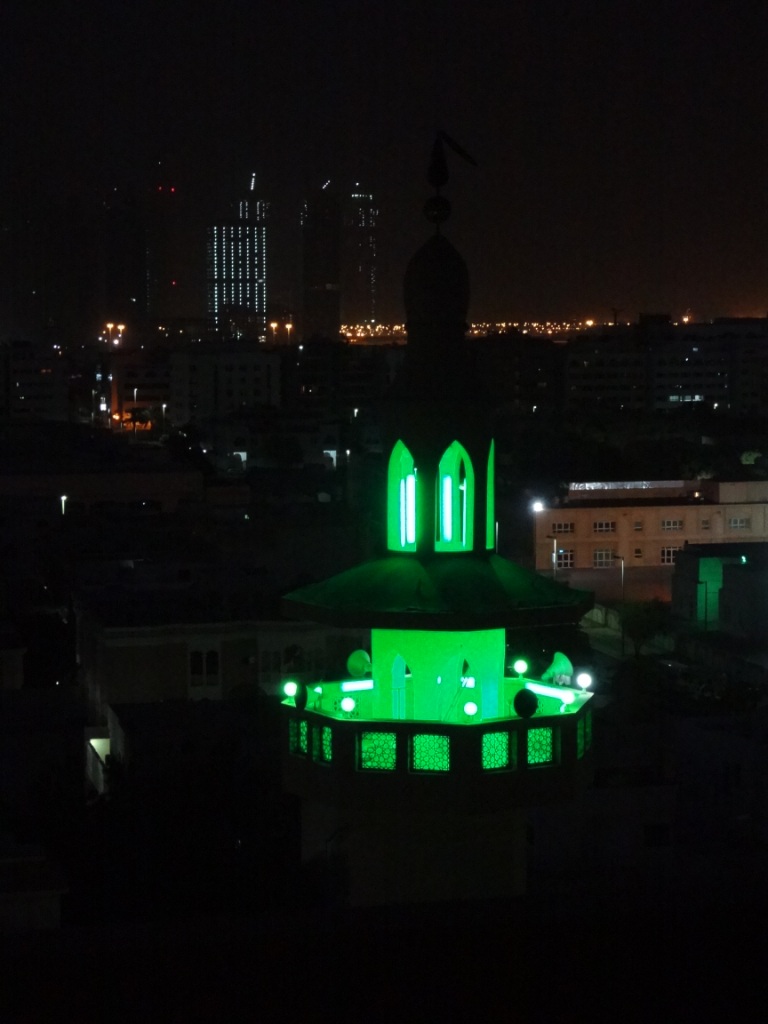
3) Sleeping through the night...without 4 am call to prayer.

View of the mosque outside our bedroom window

2) Being in the same time zone (or within 1 or 2 hours) of the people who matter most to us.

1) Being home for the holidays, and not missing major events in the lives of friends and family. Or minor ones, for that matter.

Monday, July 11, 2011

In limbo


I’ve had serious writer’s block lately, not for lack of content (there are so many topics rolling around in my head they are crashing into each other), but because I’ve been waiting for some time to find out whether I would be offered a job in Tallahassee. I had a second-round interview in mid-June, and was informed a couple of weeks ago that they were checking my references; since then, nothing but the sound of crickets and self-doubt.

Hyperactive planner that I am, I felt that until I knew the result, I couldn’t write about anything with certainty, not even to review a restaurant or relay our recent trip to the top of the Burj Khalifa. It seemed as if someone had pressed a pause button in my mind, keeping me from fully experiencing the action around me. So my last day of work came and went, our flight home looms only 10 days ahead, and I have been remiss in my self-prescribed duty to blog it.

Sam and I are living somewhat of a purgatorial existence. Our residence visas have been cancelled (giving us 30 days to leave the country). As I type this, our movers are in the other room packing our possessions to ship them across the Atlantic, leaving us with only the bare necessities. We’ve returned our rental car to Hertz, closed our UAE bank account (so long, HSBC!) and said most of our goodbyes to friends and colleagues. We know a vague outline of our future, but the details are fuzzy. And if you are still wondering if I got the job, so am I.

We continue to wait and wonder, but I’ve decided to stop holding my breath.

Wednesday, June 15, 2011

The circle of expat life

The "revolving door" is a common metaphor used to describe the UAE, with its constant influx and outflow of expatriate workers. One might argue it is a large reason why the country has a difficult time building and maintaining a solid infrastructure. No matter the organization or industry, exiting expats so often take with them their institutional memory along with their expertise, especially if there hasn't been an overlap between the old and new hire, which is more of the norm (at least in my experience here).


Thus, energetic new arrivals end up re-doing or un-doing the work that their predecessor managed to accomplish, not out of malice or incompetence, but due to a lack of history and context. I think most residents of the UAE would agree the phenomenon results in a lot of "wheel re-creating" or "wheel spinning" or whichever wheel-based cliche you prefer.

Sam and I are now entering the final stages of the expat life-cycle. Because of our career plans, we never saw ourselves staying more than a few years, but we did come to Abu Dhabi with the intention of learning as much as possible about the region and doing whatever we could to leave a positive imprint. Still, now that I have witnessed the damaging effects that an unstable resident-base can have on progress, I do have to wonder whether we are becoming part of the problem.

Happily, I get the rare opportunity to have three weeks of overlap with my replacement, so I can do my part to avoid the institutional amnesia. The new "me" arrived on Friday with her husband, and so the past several days have been somewhat of an out-of-body experience for me as I watch her go through the same levels of shock and awe that I did nearly two years ago. It's fascinating to relive it, but this time with such a different perspective and minus all the anxiety. I couldn't even blog during my first two weeks (Sam wrote all the early posts) because my brain simply couldn't process my experiences into words on a page, but there was so much to document!

For the new expat, everything that used to seem simple is suddenly an ordeal - opening a checking account, getting connected to the internet, giving directions to a taxi driver (who in most cases also just arrived in the country), or just sifting through the advice that everyone you meet bestows upon you (solicited or not). You are prodded to make important life-altering decisions while feeling disoriented and jet lagged. And all of this is peripheral to learning the actual responsibilities of the job you've been hired to do. It's an enormous load to handle all at once, and it seems you'll never get it all straightened out.

It's rewarding to look back and see how far we've come from that first week or two. We're more cynical now, perhaps, but certainly wiser. And knowing that we were able to figure things out and even come to feel comfortable in our new surroundings makes entering the next phase of our life, with all of its uncertainties, seem much less daunting.

Saturday, June 4, 2011

Cafe Arabia: bridging East and West

Last night we attended a musical event at a new coffee shop in Abu Dhabi called Cafe Arabia. Actually, it has been open at least six months already but has only now appeared on our radar, likely due to it being ensconced in a villa along 15th Street. It's likely one of those places that will thrive on word of mouth alone, and fortunately we have nothing but praise for the establishment.

The two-story cafe feels much like an Arabian home, warmly decorated, and full of light and life. Colorful artwork and stylish handmade wares are displayed for sale throughout, and the walls are studded with portraits of important regional personalities, providing instant conversation starters. Ample seating in spacious quarters, including plush sofas and family-style dining tables, is configured to accommodate a quiet chat between old friends just as well a lively discussion among new ones. The scene is cozy yet stimulating, especially when accompanied by a slice of spiced cake (ask for "my mom's cake") and mug of sweet Chai Bil Hail.


Cafe Arabia is the brainchild of proprietor Aida Mansour, who has intentionally created an environment conducive to intercultural exploration by way of the arts and, of course, through food and drink. Menu items are inspired by Middle Eastern and European family recipes, and the cafe plays host to numerous community events, such as poetry readings, lectures, and music recitals, encouraging patrons to linger in conversation over mezze and mint lemonade. 

Which brings me back to last night, when British guitarist, Jason Carter, and Emirati oud performer, Faisal Al Saari, allowed their musical traditions to intertwine, playing pieces representing both East and West in perfect harmony, and riffing off each other to demonstrate their individual talents, all before a captivated audience of about 50 gathered around on chairs and floor cushions (aka "poofs") in the cafe's upper room. The evening was also meant to publicize a project headed by Carter, called Jisr al Wadi (literally "bridge over the river," or more loosely "bridging the gap"), which is an attempt to build community between disparate cultures through music, a language which requires no translation. 


Cafe Arabia is currently an anomaly in Abu Dhabi, but will hopefully inspire similar ventures. From the number enthusiastically in attendance last night, most of whom only first heard about the event that morning when it was announced at Saint Andrews, it is obvious that the culture-cafe concept fills a void.

Located at Villa #224/1 between 2nd and 24th - Map thanks to American Women's Network

Sunday, May 22, 2011

One Gulf to another

So the big news...

Drum roll please....

Sam and I are moving back to the States! Two months from today, actually. Destination? Tallahassee, Florida. Located on the northeast shore of the Gulf of Mexico (about 20 miles inland), Tallahassee is the state capital and home to two major universities, which brings me to the reason we are moving: Sam has been accepted into a doctoral program in Islamic Studies at Florida State University, which has been the long-term plan and is finally happening!


Those of you who knew us before we were bloggers likely know this news already, and (hopefully) view it as a good thing because it means we'll soon be able to tell you our stories in person, and maybe even engage in a two-way conversation (imagine that!). But it seems that the majority of you are people whom we've never met face to face. In the past week alone we've had visits from 23 countries, spanning 5 continents! (Not that we're stalking you; StatCounter just happens to keep this data.) And we have come to know more about our readers because many of you have left comments, sent emails asking for expat or travel advice, or even re-posted our entries on your own blogs.

In a place where I often felt isolated, whether because I had a hard time finding like-minded individuals or because it was simply too hot to venture outdoors, these interactions have helped me feel connected to a larger community. And I have hesitated making this announcement (we've known since January), not because you're going to miss this blog so terribly, but because I'm going to miss you!

But I suppose if we're moving away from Abu Dhabi we can't exactly be "Finding" it anymore, and sooner or later this blog has to end. Even if I start a new one, which I probably will because it's become a way of life for me (Sam can go either way, but I pretty much think in blog now), the content that drew most readers to Finding Abu Dhabi, via Google or other means, is definitely going to change, and that means many will stop being interested. It's to be expected, but kind of hard not to feel sad about, even as I look forward to new possibilities.

For those of you who plan to stick with us until the bittersweet end, we plan to keep posting as long as there are relevant topics, but we foresee things winding down by early fall. And then what? Sam will be busy with school and pursuing his dream, and I will hopefully be starting a new job before too long. But I'll also be looking for something new to write about. Any ideas??

Monday, May 9, 2011

Between "the help" and a hard place

I had an epiphany this weekend that, short of being transported back in time, I doubt I could have understood without having lived in the UAE for a while.

It happened while watching the British television series, Downton Abbey, which portrays early twentieth-century life for a noble family and their servants on a sprawling country estate. In the second episode, a distant cousin, Matthew Crawley, who grew up as a middle-class doctor's son, is invited to live at the estate because it appears he will be the next heir to the family fortune.

Upon arrival, Matthew is overwhelmed by the slew of servants waiting to greet him. And then he is assigned a personal valet, a man several years older than himself, to wait on him hand and foot. The young heir-apparent proceeds to spend the first several days mildly annoyed that this man is always hovering, trying to help him put on his coat, pick out his clothes, and pour his tea. He repeatedly brushes the valet aside, saying "No need, I can handle it," and laments to his mother that he does not wish to be changed by his new-found station in life.

Downtown Abbey servants

Finally, after Matthew tells the valet he doesn't need help with his cuff links, the following exchange takes place (paraphrased from memory)–

Matthew: "Surely you have better things to do?"

Valet: "This is my job, sir."

Matthew: "Well it seems a very silly occupation for a grown man."

Ouch.

In the same episode, Matthew tells the master of the estate, Lord Crawley, that he has no need for a valet, and Lord Crawley wisely replies, "Would you deny a man his livelihood?"

Double ouch.

Now, I have a hard time allowing people do things for me that I can easily do for myself, such as bagging my groceries, or finding my size of jeans on the rack in a clothing store, and I feel even more strongly disinclined if I'm not expected to pay for the service. I doubt I'd ever say it to a person's face, but I would probably feel similarly to Matthew Crawley if there was a servant in my room trying to help me put on my earrings in the morning. I would assume it a waste of her time and talents.

Living in Abu Dhabi, I have been faced with comparable scenarios on numerous occasions. Essentially, this is a caste-based society where certain nationalities are paid pittances to serve and dote on other certain nationalities, and tipping is not required nor expected. It is a place where the laws and customs of the land have not left much room for social mobility. At times, it feels a bit like England in 1912.

For example, there is a team of grown men at my office, all of South Asian descent, who are employed as custodians, for all intents and purposes. They clean the bathrooms, empty the waste baskets, and refill the copier paper, all respectable jobs that need doing. However, I have more than once heard them referred to as "boys" by my colleagues, who seem to think nothing of calling them in to fetch their tea or take their inter-office mail down the hall to the drop-box. As an American, it recalls an entire history of injustice that we've worked hard to overcome, and leaves me feeling queasy.

Just last week I was leaving work carrying my laptop, purse, and a large box; awkward, but manageable. But at the front door one of the aforementioned custodians offered to take the box and carry it the short distance to my car. I thanked him, but I would not let him take it. He insisted, even reaching for the box, but I insisted more firmly. My response was instinctive, and reflected a desire to demonstrate that I view him as someone of worth, who shouldn't have to bother with such trivial tasks on my behalf. But perhaps, like the Crawley heir, I was communicating quite the opposite.

So how does a person who is not in a position of power keep from perpetuating a system of prejudice, without "denying a man his livelihood"?

I don't know yet.

Saturday, April 30, 2011

Temps drop and Sam climbs

Yesterday was beautiful. The sky was a crisp blue with no trace of haze or smog, the air was warm but not humid, and there was a slightly cool breeze coming off the water just enough to brush the hair back from my face. It couldn't have been more than 80-85 degrees (that's Fahrenheit, folks). In places of the world with four seasons, it would be your typical spring day.

palm trees in sun

But Abu Dhabi is a land of one season, summer, that expresses itself in varying degrees of warmth. It does get really pleasant from December to February, or even March, akin to early summer in Boston where you might need a light jacket at night. But for the rest of the year, afternoon temperatures nearly always reach above 100 degrees. Any exceptions are gifts that quickly expire, so it is imperative to take advantage of them.

We got iced lattes and went to one of the city's numerous public parks, which for some odd reason was completely deserted aside from us and the pigeons. We sat on a bench in a sunny patch amidst the trees and listened to the water feature trickling behind us, just soaking in the delightfulness of being comfortable outside in the middle of the day, trying to commit it to memory for when it becomes necessary to hibernate again.

Abu Dhabi parks

Then I pointed to a tree a few yards away and said wistfully to Sam, "Don't you just want to climb it?"

He did.

climbing tree

Monday, April 18, 2011

Road rage

We're back and have plenty of stories and pictures to share about our trip, but first I have to get this one out.

This morning on my drive to work, I was at a busy intersection awaiting my turn when I witnessed a man in a fancy suit get out of his fancy sports car at the stop sign directly opposite me, walk briskly to the SUV idling behind him and proceed to ream out the driver, gesticulating wildly, his coiffed hair shaking with each syllable shouted. Though I couldn't hear him over my iPod, I could practically see spittle flying out of his mouth and veins pushing their way to the surface of his beet red face.

This was one angry driver. I missed whatever action had provoked this reaction, and I missed the resolution as I had to turn right and soon lost sight of the scene, but as I continued to drive in heavy stop-and-go traffic for the next 20 minutes, I filled in the back-story myself.

First of all, I should say that what I saw this man do was the scenario I've daydreamed about since I began driving in Abu Dhabi. How often have I wished to serve up justice for inappropriate driving behaviors! For all the emphasis on politeness and protocol in the Emirati culture, the UAE roads are a place where rudeness rules, where size matters, and where drivers hiding behind darkly tinted windows act as though The Art of War1 was their driver's ed manual.

Now, I appreciate the car horn as much as the next person. It's an important tool when you feel your safety threatened or when the person in front of you is obviously not paying attention and is holding up traffic. But there is one particular use of the horn, far too common here, which causes my blood to boil with its audacity.

It happens to me, and I see it happen to other people all the time, when the driver behind you, or even several cars in the line behind you, takes it upon him or herself to decide that it is now time for you to pull out into traffic, and lays on the horn to tell you so, often encouraging others to join in the dissonant chorus. It is no matter that they do not have the proper vantage point to judge the distance and speed of the cars barreling down the road into which you are trying to enter. It is not important that they do not know the level of responsiveness or horsepower of your car. They are the all-knowing, all-powerful Abu Dhabi drivers, and you better get out of their way, even if it means compromising your own safety.

It's a form of peer pressure, really. And it's amazing how when it comes from the car behind you it carries a different tone, one that accuses you of being too timid. Chicken! you can practically hear them cry. And how unfair that there is no rear-facing horn that you could use to defend yourself. The only options are to take it sitting down, use hand gestures which may or may not translate, or get out of your car and tell them off. Of course, I would never do the latter (and probably not the middle either), but I would be willing to bet the altercation of this morning's commute was exactly that. He had simply heard one honk too many.

Interestingly, as the man carried out my own fantasy of telling off an inappropriate horn-blower, even though he was holding up a long line of cars behind him, not one toot could be heard from the other drivers. I think we were all watching in awe, silently applauding, relieved that someone finally put his foot down.

1Speed is the essence of war. Take advantage of the enemy's unpreparedness; travel by unexpected routes and strike him where he has taken no precautions. (The Art of War by Sun Tzu, 600 BC)

Wednesday, March 30, 2011

Door-to-door carpets

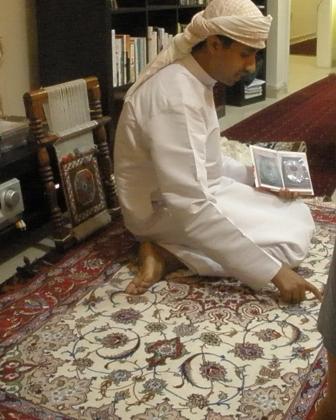
Recently, our next-door neighbor invited us over to meet "Jalal, the carpet guy," an Emirati carpet dealer with a growing reputation among Abu Dhabi western expats for providing fair prices on authentic handmade carpets, whom she had invited to make a presentation to her friends. Though he has a shop in Sharjah's Central Market, more famously known as the Blue Souk, he has developed an entrepreneurial strategy of driving directly to his customers' homes (by appointment), his car filled to the brim with carpets of all sizes. I don't know if this is a typical practice for carpet dealers, but it was an unusual sight for us to see two Emiratis, dressed in pristinely white, perfectly pressed kanduras, unloading stack after stack of carpets into our hallway.


I'm not sure who said it, maybe it was even me, but at some point in the evening the observation "this feels like a Tupperware party" left a mental imprint. A motley group was squeezed into a living room, munching on cruditĂ©s and sipping wine, listening to a twenty minute presentation about differences in origin (Afghani versus Persian versus Kashmiri), materials (silk versus wool versus kilm), and patterns (medalion, geometric, hunting, etc), followed by a tutorial on how to distinguish handmade from factory made, and how to spot differences in quality. It was pretty thorough, and by the end we were itching to start sifting through the colorful stacks in the hallway.


At last, Jalal and his assistant proceeded to lay out each and every carpet they brought, explaining the heritage, design and colors of each one. He told us to shout if we saw one we liked, and he'd set it aside for further inspection at the end. He also offered to come back with more carpets if we weren't satisfied with the evening's selection.


Though we found most of the carpets to be beautiful, Sam and I were looking for something very specific and set up a private appointment for the following evening. True to his word, Jalal arrived right on time with several more carpets based on the colors and dimensions we wanted. He allowed us to place one after another in the actual spot where it would potentially live, patiently standing aside as we debated the merits of each, until we found a perfect match. Our decision was unanimous...a silk/cotton blend from Kashmir, which is just about the softest material I've ever felt against my bare feet. Not having to drive anywhere, and being certain of the fit before buying, made it the most hassle-free shopping experience I've ever had. If only I could shop for shoes this way!


Going back to the Tupperware-party analogy, my neighbor told me that after we all left on the first evening, Jalal promised her a discount on future purchases based on his total earnings from the group, and left her with a hostess gift (a camel bag). Thankfully, this is where the similarities ended, as he did not proceed to recruit her to sell carpets (if you've been to direct-sale/multi-level marketing parties, you'll know this is hot on the agenda).

Jalal doesn't advertise, so his emergence into the Abu Dhabi market is purely by word of mouth. If you're interested, his company is Al Dar Carpets. His selection and customer service are top-notch.

Saturday, March 5, 2011

To Paris, with Lisa

Just before I moved overseas, my sister gave me this necklace, identical to one she bought for herself, as a symbol of our plan to meet next in Paris, which is conveniently located about half way between San Antonio and Abu Dhabi.


We had anticipated, and were absolutely correct, that being ten time zones apart would be the most difficult aspect of my move. Though we have lived in different cities our entire adult lives, we've never been more than one hour off, and we've always managed several visits a year. So, among the many adjustments as an expat, one was downgrading to about an hour of phone time with Lisa each month rather than our usual several hours each week, and harder still was coming to terms with the fact that we would see each other only once, maybe twice, a year.

We developed a few coping mechanisms, some working better than others. Thinking a mutual culinary experience would be a fun way to connect, we thought we'd choose one Julia Child recipe each month to cook simultaneously. But this turned out to be a bust after it dawned on us that my dinner time is her breakfast, and by the way, who besides Julie Powell, has the time to complete even one recipe from Mastering the Art of French Cooking? Julia forgot to mention her cookbook was not only for the "Servantless Cook" but the "Jobless Cook".

Another strategy was to create a Twitter feed reserved for each other's eyes only. I must say, this was a stroke of genius that came after a year of frustration over not being able to share mundane daily details with Lisa. There is a sense that our precious phone calls should be reserved for more substantive topics, but through Twitter, she can tell me that she just sneezed 100 times in a row, and I can tell her that I finally found fresh sage at the store, and we can both read at our convenience and relax that we don't have to save up and remember all of our random thoughts when we finally see each other again.

But for me, the idea of Paris has been the most important. The "City of Light" has been just that - a shining beacon among dark days of missing her. It was a place that neither of us had been but both had always wanted to visit. It was a place that seemed designed for sisters who love food and beauty and exploring urban areas. And it was something that would make much less sense if I still lived in the States. I guess we could have gone to Paris together, but meeting there sounds so much more glamorous!

Unfortunately, bad timing with work and finances, and just life in general got in the way, and the trip kept getting pushed off until we had both begun to accept it might have been just a pipe dream.

Then, a few months ago, Lisa called and said How does February sound?

Cold, I thought, but perfect!

It turns out she had been invited to style hair at Paris Fashion Week. It wasn't a guaranteed gig, but if she could find her way there and present herself when the time was right, she would probably get to participate. For a hair stylist and salon owner, this is one of the ultimate opportunities of a career, so Lisa decided to go for it, cleared her schedule for two weeks and rented an apartment in Paris. We made a plan that I would meet her there a few days early so we could get her settled in and have some time to play before Fashion Week frenzy began. We booked our flights in December, and this helped me get through yet another Christmas without her. It was really happening.

Dream. Come. True.

And just like a dream, it was over in a flash. Here are some favorite moments--

Seeing our apartment for the first time (it's the second balcony up on the right), which was even nicer than expected, in a cute and not at all touristy neighborhood near the Sorbonne.--


Going out on the balcony in the quiet of Saturday morning, and finding the quaint little square below nearly deserted--


Navigating Paris on the Metro - and the startling but funny memory of watching the doors to the train close with Lisa inside and me outside (we were reunited at the next stop)--


Enjoying the brilliant colors of the flower shops dotting the city streets - such a contrast to the gray, overcast skies--


Catching my first full glimpse of the Notre Dame--


Turning the corner off an empty side street and having my line of sight completely and unexpectedly filled by the Eiffel Tower. No longer just a trinket around my neck, but the real thing, up close and personal--


Visiting the Louvre - so beautiful--


And seeing Lisa's smile after getting her turn to photograph the Mona Lisa--


Finally, eating the most amazing meals, mostly consisting of bread, butter, cheese, wine, and chocolate! (More on this to come in the next post). This last picture below represents one of my most contented moments of the trip, as I realized everything had fallen precisely into place, but even better than I had plotted. After a long day of sightseeing, we had dolled up for dinner and then traipsed all over town in our dresses and uncomfortable shoes looking for a renowned restaurant that turned out to be closed, and then looking for a backup restaurant, which also turned out to be closed (being closed on the weekends is very big for Parisians).

Cold, slightly cranky, with stomachs beginning to growl, we found ourselves in an unfamiliar neighborhood, with no iPhone service and no idea where to eat. But then, we spotted a warm light coming from the end of an alleyway, which turned out to be an open restaurant with an open table, where the waiters were uncommonly friendly and the food was exquisite. (We found out later that we had stumbled upon the highly rated bistro of celebrity chef, Cyril Lignac, without even knowing it. I love when that happens!)

It was my last night in Paris, and a perfect one.


And it turns out, more than one dream came true in Paris - a couple of days after I left, Lisa was called up for Fashion Week duty and has since been busy styling for Nina Ricci, John Paul Gaultier, Lanvin, and Sonia Rykiel (shameless name-dropping, I know, but I'm so proud!).

Tuesday, February 22, 2011

How the other half goes to the movies

Every year, prior to the Academy Awards, Sam and I attempt to see all of the movies that are nominated for Best Picture that year, and then we compete with each other on Oscar night to see who correctly predicts the winners in the most categories (it's very official; we use ballots and everything). We've done this as long as I can remember, and I believe Sam has won every year - thanks to his upbringing and wicked smarts, he's darn good at it!

This tradition has been significantly more challenging in the UAE, as there is usually a lag time of a month or two before films make it over here, and then the good ones seem to stay only a week. And let me just say that doubling the amount of nominees from 5 to 10 has not only diluted the weight of the honor, but has made our annual attempt much more expensive! We also can't actually watch the Oscars live here since we don't have satellite; besides, they air at 5 am our time. But we press on, and are actually 9 for 10 this year, with Black Swan being the only exception (it probably won't ever release here).

Two weekends ago we noticed that The King's Speech was finally showing, so we went to Marina Mall Cinema at the scheduled time only to be told there was a problem with the film and it wouldn't show after all. So we drove across town to the Khalidiyah Mall Cinema, to find out it was only playing in "Platinum Class" for a whopping 100 dirhams ($28) per person! We asked if the film would be available anytime soon at the regular price of 30 dirhams and were informed that this was the last day it would be in theaters at all. After a private consultation, Sam and I agreed we had come too far to turn back and coughed up the extra dough. 


So, what does 100 dirhams get you at the movies? Well, not much. We were directed to a separate entrance to sit in a private lobby that looked, well, like a smaller version of the main lobby. I visited the "platinum class" bathroom to see what extra amenities I might find, but apart from a more stylish sink basin, it was the same as the regular class bathroom (and out of paper too). Our movie was shown in a smallish room with a smallish screen, with just two distinct differences from a regular-priced movie: 
  1. Rather than wait in line at a concessions counter, theater employees come around to your seats to take snack orders. There are no special offerings; same candy, same prices as always, but in Platinum Class you get to listen to everyone around you give their orders during the previews, then wait until 20 minutes into the movie to get your M&Ms, all the while being distracted by the waiters attempting to discreetly distribute popcorn in the dark (not an easy feat).
  2. The seats! Everyone gets their own personal Barcalounger (aka Lazy Boy), soft as a baby's bottom and fully reclinable. We took off our shoes (everyone was doing it) and settled in for the duration, deciding the ticket was worth every last dirham.

Saturday, February 19, 2011

A tale of two tailors

It was the best of days, it was the worst of days…

I accidentally cut a hole in my brand-new black pants (don't ask) and needed them mended before my big trip to Paris (that's right, I'm going to Paris in a few days!). Despite a sewing class in high school (again, don't ask), I have absolutely zero affinity for anything involving needles and thread, and so I began to look around for a professional tailor.

I first went to my dry cleaner, because back home that would be the place to go if you needed to replace a button or tighten a seam; but alas, neither do they mend or know of anyone who mends.

I turned to the internet next. But since it is rare for a business in Abu Dhabi to have its own website, the results of a Google search produced mostly discussion forums where other expats had relayed their various tailoring experiences. After reading several posts, I decided to go with Noor Al Balooshi, a tailor who had received decent recommendations, but also, and possibly more importantly, for whom someone had posted directions with street names and even a couple of landmarks. In a city that does not use a street address system, good directions are worth their weight in gold.

So last Saturday, I kissed Sam goodbye and told him if I wasn’t back by lunch to come looking for me. Why the drama? You see, I could tell from the directions that Noor Al Balooshi was going to be found deep inside one of Abu Dhabi's countless labyrinthine-like neighborhoods that are enclosed within a city block. In other parts of the developed world, the areas of concrete which surround buildings are typically used as dedicated parking lots. But here, these patches of pavement have morphed over years of improper zoning into intricate mazes of alleyways, overgrown with mom-and-pop grocers, pharmacies and specialty shops, barbers and mosques. There are cars parked and double-parked along every inch of curb, allowing room for only one vehicle at a time to pass in many places, with no traffic signs, and few exits to the main roads. I usually avoid these areas lest they swallow me whole; going in on purpose shows how badly I wanted my pants fixed.

Long story made short not as long, the directions turned out to be little help, lacking crucial details like whether to turn left or right at said landmarks. Nearly an hour later, after backing out of (literally) a traffic-jam in which I briefly considered abandoning my vehicle, and then miraculously avoiding a collision when a taxi on my right, without warning, took a sharp left in front of me as I was going straight through an intersection, I had not found the tailor, nor any other establishment appearing to contain a sewing machine.

What I had found was a new disdain for the city of Abu Dhabi. Why should it be so hard to complete such a simple errand?! Fighting back tears of frustration, radio blaring, I made my way out of that cramped part of town and headed out to the Corniche (the road hugging the coast) so I could drive fast and blow off some steam.

Feeling a little calmer and heading back toward home, I spotted out of the corner of my eye a sign on a small side-street that might have said something about tailoring. I had already passed the street so I started the laborious process of turning around (this could be another post in itself). After what seemed like an eternity, I approached the same side street again, and...voilĂ ! A tailor!


Five minutes later, I had left my pants plus a few other altering projects with Amin and his lone sewing machine in a tiny but immaculate shop called Senyorita Ladies Fashion Tailoring (gotta love the use of misspelled Spanish).

Amin was cheery, and despite his limited English, understood each of my requests, quickly measuring and marking for a hem here, a patch there. I asked how much time he needed to complete the work, expecting to wait a week or so, but he responded, "I finish today. You come tonight." I asked the price, and he thought a moment then said tentatively, "Fifty dirhams?" I think he was waiting for me to negotiate, but to me fifty dirhams (less than 14 USD) for mending seven items seemed outrageously low. Best of all, the work he completed turned out to be flawless, way better than my tailor in Boston who would charge me 14 bucks for one hem. I left his shop glowing from my find: a reliable tailor and a new reason to love Abu Dhabi.

I told Amin I would tell my friends, so here they are, drama-free directions to Senyorita Ladies Fashion Tailoring, in Al Khalidya:

Get on Sheikh Zayed the First (7th) Street, heading away from Khaleej Al Arabi (30th) and toward 26th. Go past 16th street, and then be looking for a small street on your right in between the blue First Gulf Bank building and the pink Folklore Gallery building. Turn onto this street (8th), and you'll immediately see the tailor on your left, a couple doors down from the gallery. (Incidentally, there is an African + Eastern nestled in the parking lot behind First Gulf Bank, which I never would have found otherwise.)

Wednesday, January 19, 2011

Sense of humor required

I’ve lived overseas long enough that I can no longer recall whether the following scenario, which is representative of many of my customer-service experiences here in the UAE, would be considered normal back home. My American readers can judge for themselves.

On Monday, I went to a local supermarket to pick up a prescription at the pharmacy. I stopped at the HSBC-owned ATM machine to get cash to pay for the prescription, but absent-mindedly inserted my credit card instead of my debit card. I didn’t notice though, because the machine went through the normal motions - asking for my PIN number, which I entered, and then asking me to choose the amount of cash I wanted, which I did.

I still wasn’t aware anything was wrong until it suddenly spit out a receipt with the following message: “Cash withdrawal cancelled. Card retained. Please contact the bank.” I opened my wallet to find my debit card snugly tucked inside, and I finally understood my mistake. But there was no second chance, no “invalid pin” or “invalid card” error messages to alarm me to my idiocy. It just ate my card without warning! I could almost hear it belching with satisfaction.

Fortunately, this particular store has an in-house branch of HSBC, so I immediately went in, showed a teller the receipt and asked if he might retrieve it. Unfortunately, his reply was “Oh no, ma’am, we don’t have a key to the machine. You’ll have to wait a couple of days and then go to the main branch to pick it up on any week day between the hours of 10 and 2.” I told the man in no uncertain terms how ridiculous I thought the situation was, but rather than defend his employer, he smiled and said apologetically “welcome to HSBC.”

I guess he was trying to appease me, but it actually made me angrier to know there wasn’t a good reason for this inconvenience. HSBC is already on my list for its website constantly crashing and for making it nearly impossible to pay for things while we were in Istanbul [note to international travelers: always carry several methods of payment, from more than one banking source], so I was low on patience.

The man then conferred in Arabic with his colleague, turned back to me and said, “I tell you what, I’ll give you the number of a man to call at the main branch so you can call ahead and make sure he has it. His name is John. That way you won’t waste your time.” Right, I thought, wouldn’t want to waste my time. To top it off, the pharmacy was out of my prescription so I left the store even more empty-handed.

It has now been two days since the incident, so a few minutes ago I called the number for "John." An automated female voice with a refined British accent told me that no one was available at that number (no mention of John was made, or even of HSBC come to think of it) and that I could leave a message except for the fact that the voicemail box was full.

“I shall now transfer you to an attendant,” she chirped, “but, oops, no alternate extension was entered by the owner of this mailbox, so there is absolutely nothing I can do but end this call. Too bad, so sad.” Click. (There may have been a bit of paraphrasing there, but not much.)

There is nothing to do but laugh. Oh, and call back. Because I still need my credit card.

Tuesday, January 11, 2011

A foodie in the UAE: thank God, it's organic!

Yesterday, I went to the mall on my lunch hour to look for fresh rosemary to use it in last night's soup. [I should explain that every mall in Abu Dhabi has a huge supermarket (which they call a hypermarket) as one of its anchor stores; otherwise, I would not typically go to a mall looking for herbs.] Anyway, entering the mall I was greeted by the sound of live music, and as I approached the grocery store I could see a line of Emirati men singing into microphones while a half a dozen others did a traditional dance.

Apart from on National Day, seeing Emiratis singing and dancing in a public space is very unusual. I was intrigued, but short on time and on a mission, so I kept walking toward the store. But then I stumbled upon what appeared to be the World's Longest Cake, elaborately decorated as a cityscape of Abu Dhabi, at which time I stopped a few moments to take it all in.


I didn't know yet what we were celebrating. All of the signs hung around the cake were in Arabic, so I thought maybe it was a local holiday I wasn't familiar with. I decided to run quickly into the store to complete my errand and then find out the reason for the excitement.

In the produce section I didn't find any rosemary but I did find this--


I gasped as I grabbed the most beautiful head of lettuce I've ever seen, which was flanked by bushels of exquisitely fragrant tomatoes, peppers, onions, and squash. Where did all this come from? In 17 months, I haven't seen vegetables near this caliber. With the ordeal of importing and the ornery heat, most produce arrives on shelves bruised and sad-looking. Even the wimpy "organic" sections of the grocery store offer up wilted leaves that costs a week's salary. I circled the display until I found a sign in English - and I think I heard the Hallelujah Chorus playing in the background as I read: Organically grown in Abu Dhabi.

Around the corner from the store I found a pseudo-farmer's market showing off the treats that we can come to expect from Mazaraa, "the first organically certified products in the UAE," according to the free pamphlet.


I now understood what the singing and dancing was about. I felt a bit of pride for this little country for moving in this direction; finding sustainable ways of producing their own food will be key to the UAE's continued growth and progress. It looks like they are pretty proud of it too--

UAE flag in vegetables

Not only are these vegetables divine to look at, they are surprisingly inexpensive. Typically, to buy four non-organic, average-sized bell peppers and barely edible lettuce would cost me at least 25 dirhams (nearly $7). But four huge peppers and a giant head of Romaine from Mazaara cost me about 10 dirhams (not even $3). And check out these beauties! Stuffed peppers are on the menu tonight --